-
748 Views
shares
When something is important enough, you do it even if the odds are not in your favor.
Elon Musk
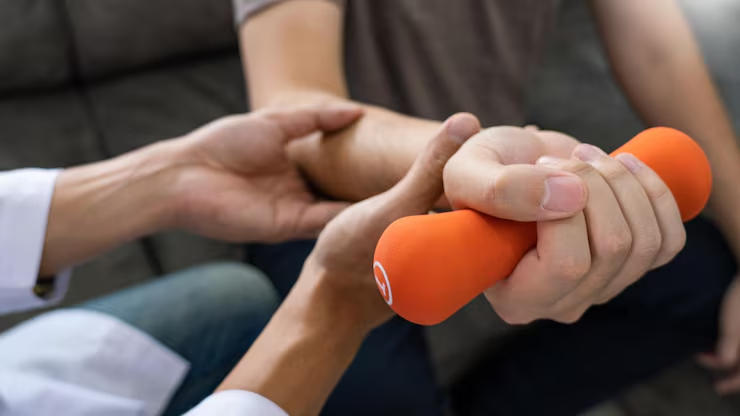
Every year, millions of people face life-changing challenges after a stroke or serious injury. One of the hardest to overcome is the loss of hand mobility. Suddenly, simple tasks like drinking from a glass, holding a phone, or buttoning a shirt become frustrating and often impossible. This loss of independence affects not only the body but also confidence, relationships, and overall quality of life.
For a long time, hand rehabilitation after stroke has relied on traditional therapy. While therapy remains essential, progress is often slow and many patients never fully regain function. More than half of stroke survivors live with lasting limitations in hand use. This can leave them dependent on caregivers, unable to return to work, and struggling with daily activities.
But change is happening. Thanks to advances in medical technology, there is now real hope for faster and more effective recovery. Soft exoskeletons, smart gloves, and AI-powered medical devices are transforming what rehabilitation can look like.
Breakthrough Research on Soft Exoskeletons
In August 2025, researchers studied a device called the RELab tenoexo 2.0, a soft robotic exoskeleton created to help stroke survivors regain hand movement. The results were impressive.
Patients who used the device showed measurable improvements in grip strength, finger coordination, and functional use of their hands. They were also able to perform everyday tasks more independently, from eating and grooming to small household chores.
Unlike older rehabilitation tools, this exoskeleton was designed to be lightweight, wearable, and easy to use. Instead of forcing movement, it worked with the patient by reading biosignals from the muscles and turning them into natural motions. This approach not only supported physical recovery but also gave patients the experience of being in control again.
The study offered clear evidence that soft exoskeletons for stroke recovery can make a real difference. They provide support, motivation, and improved outcomes that traditional therapy alone often cannot deliver.
Why Innovation Matters in Hand Rehabilitation

Hand function is central to independence. Think about how often you rely on your hands each day: writing a note, cooking a meal, sending a message, or picking up your child. When this ability is taken away, it creates physical, emotional, and social barriers.
Traditional therapies are important, but they often require long sessions at specialized clinics, and progress can be slow. Many patients lose motivation over time, especially when improvements feel small or inconsistent.
Technology offers a new way forward. Devices that combine robotics and biosignal control can help patients see immediate results. Each successful grip or movement reinforces the brain’s ability to relearn control, a process known as neuroplasticity. By creating this constant feedback loop between the brain and the hand, recovery becomes more effective and more encouraging.
How NeuroRevive is Shaping the Future
At NeuroRevive, we are dedicated to giving patients their independence back. We are developing a next-generation device that builds on the success of studies like the one with the RELab tenoexo.
Our solution is a fully wireless, AI-powered hand rehabilitation device. It uses surface EMG sensors to detect tiny signals from the muscles, then translates those signals into precise, natural hand movements. Advanced algorithms ensure that every motion feels smooth and responsive.
Because it is lightweight and portable, patients can use it not only in a clinic but also at home, during everyday tasks, or while traveling. This flexibility means therapy does not stop when the appointment ends. Instead, rehabilitation becomes part of daily life, helping patients build strength and coordination more consistently.
Our mission is simple: to restore movement and independence in a way that feels natural, motivating, and life-changing.
Benefits Patients Can Expect
The combination of soft robotics, biosignals, and AI brings a wide range of benefits to patients recovering from stroke:
Motivation and progress you can see – Each time the device helps you complete a movement, you feel the achievement immediately, which keeps you motivated.
Personalized rehabilitation – AI technology adapts to your progress, adjusting assistance as you grow stronger.
Recovery at home – Because the device is portable, patients can continue therapy outside of clinical sessions.
Better long-term results – Consistent use strengthens both muscles and neural pathways, speeding up recovery.
Improved quality of life – Regaining the ability to manage daily activities brings confidence and independence back.
Looking Ahead
The recent study of the RELab tenoexo 2.0 proves that technology is already changing rehabilitation. Devices that respond to biosignals and support natural motion are no longer just concepts. They are here, and they work.
At NeuroRevive, we are proud to be part of this progress. Our goal is not just to help patients recover movement but to help them regain the freedom to live fully. With every advancement in soft robotics and AI, we move closer to a future where stroke survivors have more independence, more confidence, and more hope.
📖 Read the full research study here: Soft exoskeleton study – PMC.